Series № 1 of 2 Burner Bench
Viking Burner Clicks But Will Not Light: What It Usually Is
One sealed burner clicks away and never lights while the rest catch at once, or several go slow together on a busy evening. The clicking is good news; what it points at depends on which burner, and when.
Written by
Sofia Alarcon
- Role
- Service technician — refrigeration and defrost
- In the trade
- 15 years in the trade
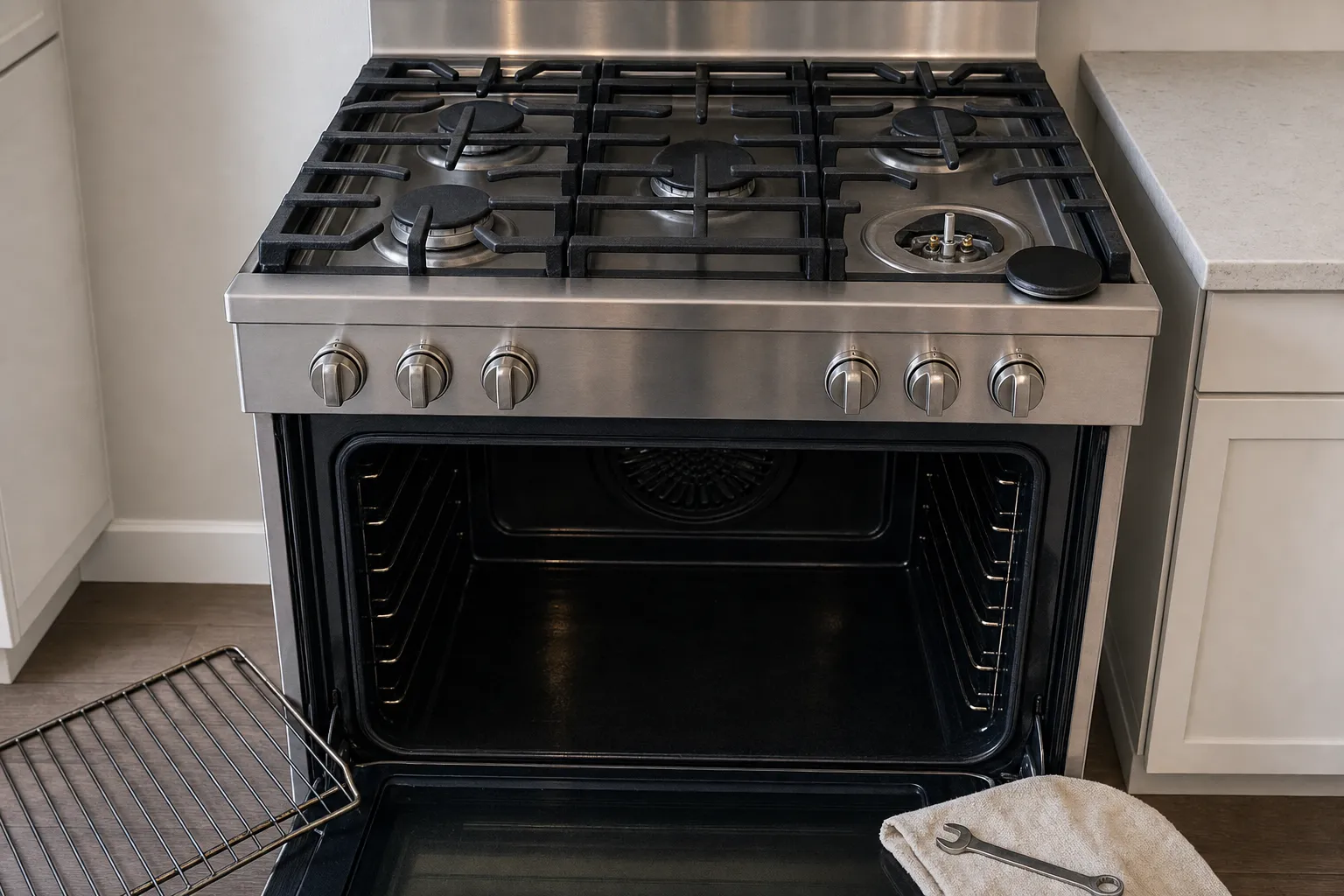
What is the clicking actually telling you?
That the ignition works. When a knob opens, the module sends a spark to the electrode beside the burner, and on most Viking cooktops every electrode clicks at once, so hearing all of them is normal.
What is missing is a burnable mix of gas and air at the spark gap. Four things take it away: a cap out of place, ports blocked, an electrode that is wet, dirty or cracked, and gas arriving at too low a pressure. The first three are cheap. The fourth is the one most often priced as a failed module.
Card 1 of 8 · (425) 321-3414
Does the pattern point at the burner or at the gas?
Read it before touching anything.
- One burner, any time of day, the others fine: that burner’s cap, ports or electrode.
- Right after a boil-over or a wipe-down: a wet electrode, usually on more than one burner.
- Worst on the largest burner, worse with others running, worst when other gas appliances are drawing too: pressure.
On the acreage kitchens above the valley, this third pattern is the one most easily mistaken for a failed module.
Card 2 of 8 · (425) 321-3414
Is the cap sitting where it should?
A Viking sealed burner is a stack: the base with its ports, the head, and the cap on top, which has to sit flat and fully home. Knock it a millimetre out of place with a pan or a wash and the gas no longer passes through the spark gap.
Take the cap off cold. Its underside should be clean metal, and the ports round the head should be open holes, not a baked ring of spill. A straightened paperclip or a stiff brush opens a port; a drill bit never should, because it leaves the hole larger. Set the cap back square, and check a simmer cap has not been swapped onto a larger burner after a deep clean.
Card 3 of 8 · (425) 321-3414
Is the electrode wet, dirty or cracked?
The electrode is the white ceramic post at the edge of the burner, with a metal tip.
Wet is the commonest and cures itself: after a boil-over or a wet wipe, the spark tracks to earth through the moisture instead of jumping to the burner. Leave the range off with the caps removed for a few hours.
Dirty means a film of carbon or grease on the tip. Wipe it dry once the range is cold.
Cracked needs a part. A hairline crack lets the spark leak to the chassis, and you can often see it jump to the wrong place. The electrode is inexpensive; reaching it is the labour.
Card 4 of 8 · (425) 321-3414
Why does the gas supply come under suspicion here?
Because kitchens on older acreage properties have usually been changed more than once. The shutoff behind the range is left part-closed after an appliance swap. A flex connector kinks when the range is pushed back. A regulator is not set right after a change of gas. Or a supply that was ample for the kitchen now also feeds a grill island.
Each of these starves the burners in the same way, and none of them is visible from the cooktop.
Card 5 of 8 · (425) 321-3414
How is low pressure proven?
With a manometer on the range’s pressure test point, read with the burners under load, and compared with the figure Viking gives for your gas in the installation guide. A reading taken with one small burner on proves little.
This is not homeowner work. It is worth knowing it exists, because whoever has not taken that reading is in no position to say the module is bad.
Card 6 of 8 · (425) 321-3414
When is it really the ignition module?
The module is the last suspect. What points at it:
- No clicking at all, from any burner, with the range powered.
- Clicking that never stops, after the burner lights and after every knob is off. Switch the range off at its breaker until it is seen; a module that sparks continuously is a fire concern.
- One burner that never sparks while the others do, with a sound electrode and lead.
Clicks-but-will-not-light is not on that list.
Card 7 of 8 · (425) 321-3414
What can you do before booking?
Re-seat every cap, clear the ports of the burner that will not catch, and give a wet electrode its hours to dry. Wipe a sooty tip. That settles a fair share of these calls.
Stop there. The manifold, the regulator and the ignition wiring are gas and electrical work, and they need a meter and a manometer rather than a screwdriver.
Card 8 of 8 · (425) 321-3414
Follow-ups
Why does it light on a quiet morning but not on a busy evening?
That timing points at gas pressure. With one burner on, a marginal supply still delivers enough; with several burners, the oven and perhaps a water heater drawing at once, the pressure sags and the weakest burner stops catching. A manometer reading under load settles it. Woodinville Viking Repair, (425) 321-3414, takes that reading on the visit.
Will a new ignition module stop the clicking?
Only if the module is the fault, and clicking without lighting is not one of its signs. A module that works is already making the spark you hear. Replace it while the real cause is a cap, a wet electrode or low pressure, and the new one clicks just the same. Woodinville Viking Repair, (425) 321-3414, measures before naming it.
Could a new outdoor kitchen be starving the range?
It can, if the grill island was teed into a line sized for the kitchen alone. A range that went lazy after the patio work, and struggles most while the grill is lit, deserves a pressure reading. Resizing the gas line is a gas fitter's job; the reading that shows whether it is needed comes from Woodinville Viking Repair, (425) 321-3414.